Questions to Ask a Gutter Contractor Before You Hire
Hiring someone to work on your home is a bigger decision than it sometimes gets treated. Gutters aren't glamorous, so homeowners often default to whoever answers the phone first or quotes the lowest number without asking much else.
That approach works out fine sometimes. Other times it means a crew that rushes the job, uses undersized material, or disappears when something goes wrong six months later.
A few direct questions before you hire can tell you a lot about who you're dealing with. Here's what to ask — and what the answers should sound like.
Are You Licensed and Insured?
This is the first question, every time, no exceptions.
General liability insurance protects you if something goes wrong on your property — a ladder accident, accidental damage to your roof, siding, or landscaping. Workers' compensation covers the crew if someone is injured on the job. Without it, you could be liable.
Any legitimate gutter contractor will have both and will provide proof without hesitation. If there's any reluctance, hedging, or claims that insurance "isn't really necessary for this type of work," end the conversation.
Missouri doesn't require a state license specifically for gutter contractors, but asking about licensing opens a broader conversation about how the business operates and whether they carry the credentials their trade association or local municipality might require.
Do You Specialize in Gutters, or Is This One of Many Services You Offer?
This isn't a disqualifier either way, but the answer matters.
A contractor who installs gutters as part of a broader home services operation may do perfectly good work. But a company whose primary focus is gutters — installation, replacement, repair, cleaning — has done the job thousands of times. They've seen every failure mode, they know the right material gauges, they understand proper pitch and hanger spacing, and they catch things a generalist might miss.
When someone does one thing every day, they get very good at it. Ask the question and listen for confidence versus vagueness in the answer.
What Type of Gutters Do You Install — Sectional or Seamless?
If you're replacing gutters or installing on a new home, this question matters significantly.
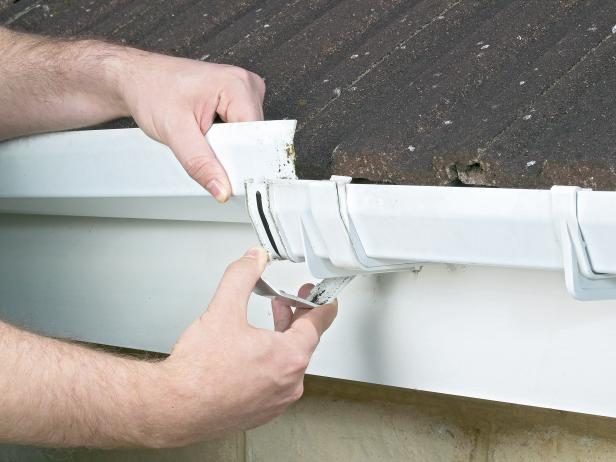
Sectional gutters come in pre-cut lengths and are joined together with connectors at regular intervals. Those joints are where leaks start. Every seam is a potential failure point that expands and contracts with temperature, collects debris, and eventually separates.
Seamless gutters are cut on-site to the exact length of your roofline — one continuous piece with no seams along the run. The only joints are at corners and downspout connections. Fewer failure points, better long-term performance, cleaner appearance.
Not every contractor offers seamless. If yours doesn't, it's worth understanding why and whether that's the right fit for what you need. Our [seamless gutter installation page] covers the differences in more detail if you want to go deeper before your conversation.
What Gauge Aluminum Do You Use?
This is a question most homeowners never think to ask, and it's one of the places where corners get cut quietly.
Standard residential gutters are typically .027 gauge aluminum. That's the minimum you'd want for most homes. Better installations use .032 gauge — thicker, more rigid, more resistant to denting and warping. The difference in material cost is small. The difference in longevity over ten or fifteen years is meaningful.
A contractor who uses quality material will know the gauge they work with and tell you without hesitation. A vague answer — "standard aluminum," "whatever's standard" — is worth following up on.
How Do You Handle Hanger Spacing?
Hangers are the hardware that attaches the gutter to the fascia board. They do the structural work of keeping the gutter in place through weather, debris load, and thermal expansion.
Industry standard is one hanger every 24 to 36 inches. A quality installation is typically closer to 24 inches, especially in climates like southwest Missouri where gutters deal with ice buildup in winter and significant storm load in spring. Wider spacing means more flex in the gutter run, which means more stress on the joints and more potential for sagging over time.
Ask specifically. If the contractor knows their craft, they'll have a number ready.
What Does Your Warranty Cover?
There are two different warranties to ask about: the material warranty from the manufacturer, and the labor warranty the contractor stands behind.
Material warranties on quality aluminum gutters typically run ten to twenty years. The labor warranty — which covers the installation itself — varies widely by contractor. Some offer one year, some offer five, some offer nothing in writing at all.
Get it in writing. A contractor confident in their work doesn't hesitate to back it up.
Can You Provide References or Point Me to Your Reviews?
Past customers are the most honest signal available. A company with a strong track record in the Springfield area will have Google reviews you can read, and ideally references from recent jobs they're willing to share.
Pay attention to patterns in the reviews more than individual comments. Consistent themes — showed up on time, did what they said, cleaned up after themselves, straightforward pricing — tell you more than a single five-star write-up.
Also note how the company responds to negative reviews. A contractor who handles criticism professionally and tries to make things right is telling you something useful about how they'll handle a problem if one comes up on your job.
What's Included in the Written Estimate?
Before any work starts, you should have a written estimate that clearly spells out the scope of work, the materials being used, the total cost, and the payment terms.
Vague estimates protect the contractor, not you. An estimate that says "gutter work — $X" leaves room for disagreement about what was supposed to be included. A detailed estimate that lists linear footage, material gauge, number of downspouts, hanger spacing, and any additional work like fascia repair or end cap replacement gives both parties a clear agreement.
If a contractor is hesitant to put the details in writing, that hesitation is information.
One Final Thing
The best gutter contractors welcome these questions. They've heard them before, they have clear answers ready, and they know that a homeowner who asks good questions upfront is a homeowner who will be satisfied with the job.
If you're looking for a gutter contractor in the Springfield area who will give you straight answers to all of these, K Brothers Seamless Gutters serves homeowners throughout Springfield, Nixa, Ozark, Republic, Battlefield, and Rogersville. [Reach out here] to get an estimate or ask us anything on this list.