How Often Should You Clean Your Gutters?

Most homeowners know they're supposed to clean their gutters. Fewer know how often, and even fewer actually follow through on a schedule.
The default advice you'll see everywhere is "twice a year." That's a reasonable starting point — but it's not the full answer. How often your gutters actually need cleaning depends on your trees, your roof type, your gutter setup, and where you live.
This guide gives you a straight answer based on your specific situation so you're not cleaning more than you need to — or less than you should.
Why Cleaning Frequency Actually Matters
Gutters clog in layers. Leaves fall, get wet, compact down, and form a mat. More debris lands on top. Eventually the channel is blocked and water has nowhere to go except over the edge or back toward the fascia.
The problem isn't just the overflow — it's everything that follows. Water sitting against the fascia board causes rot. Water pooling at the foundation causes long-term structural issues. Standing water inside the gutter itself attracts mosquitoes and accelerates corrosion.
Cleaning on the right schedule keeps all of that from starting. The question is what that schedule looks like for your home.
The Standard Twice-a-Year Schedule
For a home with moderate tree coverage and standard sectional or seamless gutters, cleaning twice per year is the baseline recommendation.
The timing matters. Most gutter professionals in southwest Missouri recommend cleaning in late fall — after the last leaves have dropped — and again in early spring, before the heavy rain season arrives. That timing addresses the two biggest debris events of the year: fall leaf drop and spring seed, pollen, and storm debris accumulation.
If your gutters are in good shape and your tree coverage is moderate, this schedule is sufficient. You clean in November, you clean in March or April, and your gutters are ready for whatever Missouri spring throws at them.
When You Need to Clean More Often
Twice a year is a floor, not a ceiling. Several factors push cleaning frequency higher.
Heavy tree coverage
Homes with oak, sweet gum, or maple trees directly overhead see significantly more debris than homes with minimal tree coverage. Pine trees are particularly aggressive — they shed needles year-round, and those needles slip through coarser gutter guards and pack tightly in channels.
If you have large trees within fifteen to twenty feet of your roofline, three cleanings per year is more realistic. Some heavily wooded properties need four.
You have a steeply pitched roof
Steeper roofs shed debris faster and direct more volume into the gutters below. More shingle granules wash down with every rain, and debris from the roof accumulates more quickly in the gutter channel. If your home has a steep pitch, plan for more frequent attention.
You've had clogging problems before
If you've dealt with overflowing gutters in the past, that history is telling you something. Either your current cleaning schedule isn't frequent enough, your gutters aren't properly pitched, or there's a capacity issue. More frequent cleaning is the easiest first adjustment.
You have open-top gutters with no guards
Unprotected gutters collect everything. There's no filter, no barrier — leaves, twigs, seed pods, shingle grit, and storm debris land directly in the channel. Without guards, regular cleaning is your primary defense.
When Twice a Year May Be Enough
Not every home needs aggressive cleaning. If the following describes your property, the standard schedule likely holds:
Your yard has minimal tree coverage or trees that are well back from the roofline. You've had gutters cleaned before and they weren't significantly clogged. Your home has quality seamless gutters in good condition. You've added gutter guards with a fine mesh screen.
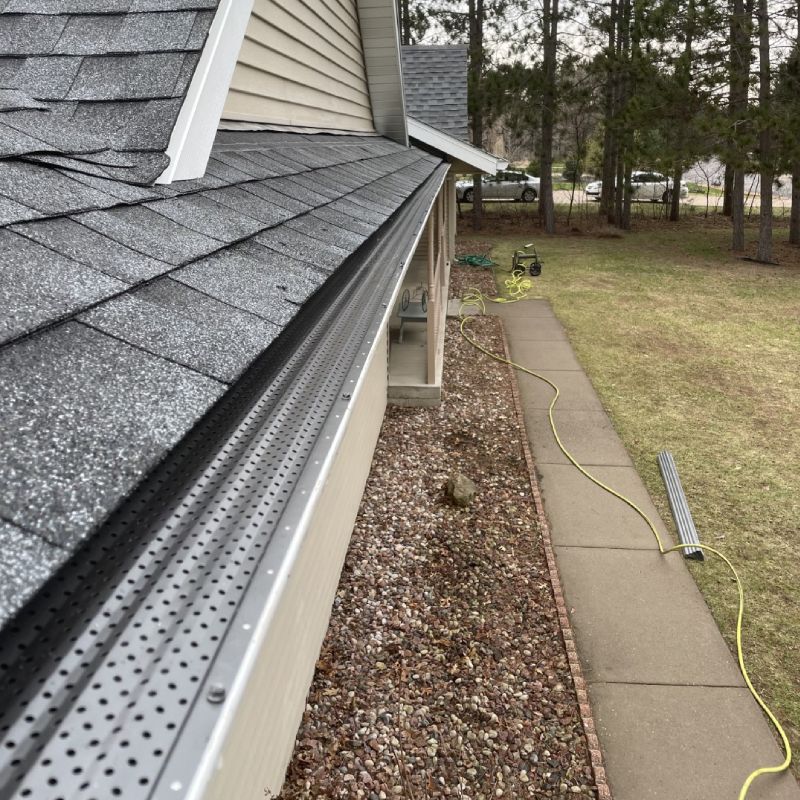
Gutter guards don't eliminate cleaning, but they meaningfully extend the interval between it. A home with micro-mesh guards and moderate tree coverage may need cleaning once a year rather than twice. If you're curious whether guards make sense for your home, our [gutter guard installation page] walks through how to think about that decision.
Signs Your Gutters Need Cleaning Now
You don't always need to wait for a scheduled cleaning. A few visual and functional cues tell you it's time regardless of where you are on the calendar:
Water spilling over the front edge during rain is the most obvious sign — that's a blockage somewhere in the channel. Plants growing out of your gutters mean debris has been sitting long enough to support growth. Sagging sections indicate accumulated weight from wet, compacted material. Dark streaks running down your siding from the gutter line suggest overflow that's been happening consistently. Insects or birds showing persistent interest in your gutters can signal standing water or nesting material inside.
Any one of these is a prompt to schedule a cleaning regardless of the last time it was done.
What Professional Cleaning Includes
A professional gutter cleaning goes beyond pulling out visible debris. A thorough job clears the full channel from end to end, flushes the downspouts to confirm they're draining freely, checks that hangers are secure and gutters are properly pitched, and flags any developing issues — cracks, separated seams, sections pulling away from the fascia — before they become bigger repairs.
That last part matters. A cleaning is also an inspection. Catching a loose hanger or a small crack during a routine cleaning is significantly cheaper than addressing water damage to the fascia or foundation a year later.
K Brothers provides gutter cleaning for homeowners throughout Springfield, Nixa, Ozark, Republic, Battlefield, and Rogersville. If you're unsure when your gutters were last cleaned or you're seeing signs of buildup, [reach out here] to get on the schedule.